
Blog
While Giants Wage Oil Wars: How Swedish Startup Havstraum is Revolutionizing Water Desalination
While global players divide markets, wage price wars over oil and gas, and distort hydrocarbon costs to balance their budgets, technologies that could leave old approaches in the past are being born in the shadow of geopolitical battles. Within the walls of KTH the Royal Institute of Technology in Sweden, engineers have developed a method that solves one of humanity’s greatest challenges completely without the use of diesel or grid electricity.
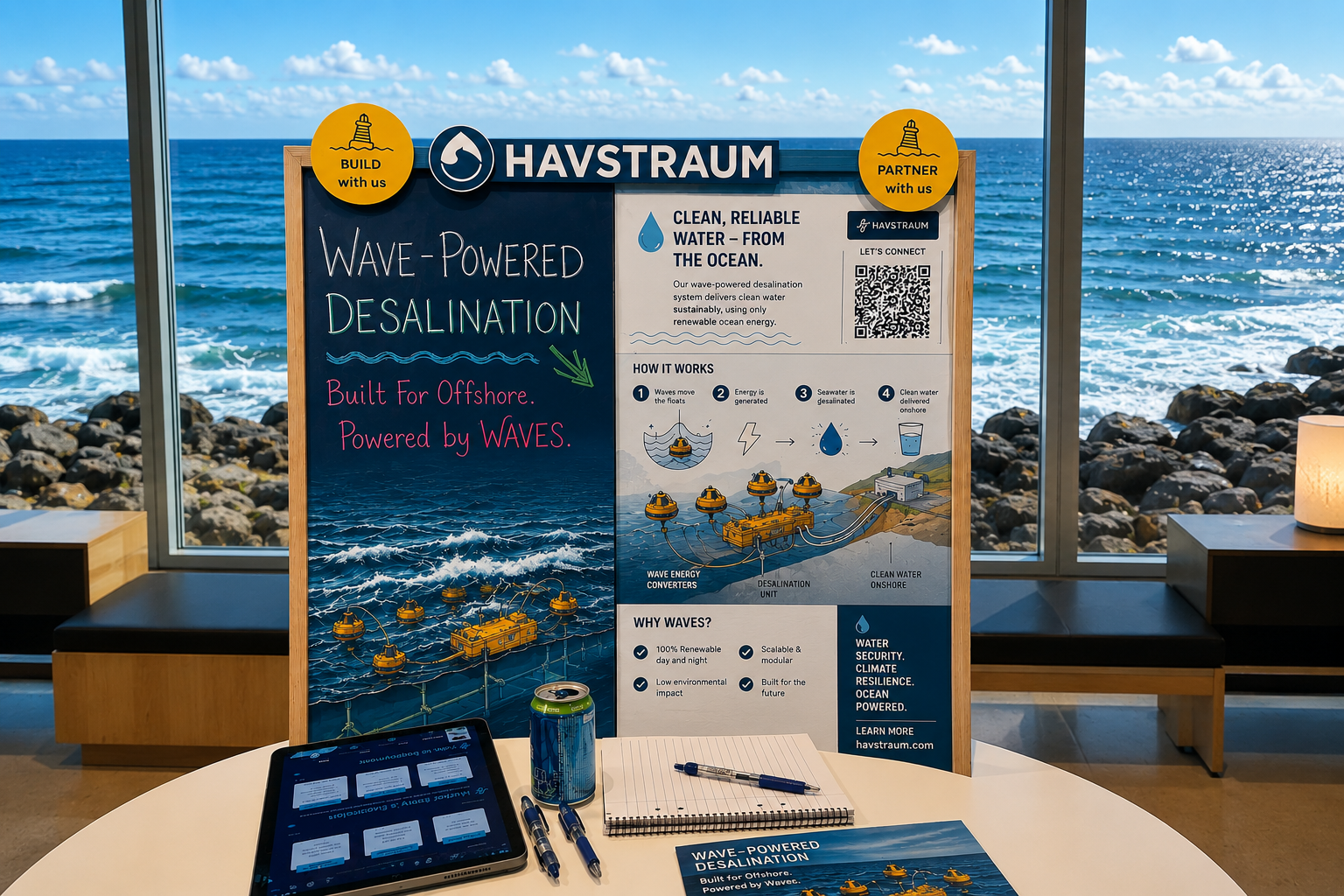
The startup Havstraum has found a way to desalinate seawater using nothing but the kinetic energy of ocean waves.
The Core Innovation of KTH Engineers
Traditional desalination (reverse osmosis) is an environmental dead end. To push saltwater through filters, massive pumps are required, burning tons of diesel. They are saving regions from drought while accelerating global warming.
The innovative breakthrough of KTH engineers lies in a direct hydraulic drive that completely removes electricity from the equation:
Direct Mechanics: The movement of ocean waves directly drives specialized buoys and hydraulic pistons.
Natural Pressure: These pistons directly compress the seawater, instantly creating the massive pressure needed for filtration.
Zero Middlemen: The system requires no generators, wiring, or fossil fuels. Wave energy is converted directly into a stream of fresh water with an absolute zero carbon footprint.
Why is This Possible Only Now?
Attempts to harness waves have been made before, but the machinery would quickly degrade in the harsh, corrosive saltwater. Recent global breakthroughs (including US developments and patents in related fields) have finally made this technology viable:
1 Advanced Materials Science: The use of cutting-edge composite polymers that do not corrode in seawater and can withstand extreme friction.
2 Digital Fluid Dynamics: Modern software allows for millisecond-precision valve control. This “smoothes out” the erratic tempo of storms and waves, delivering a stable, safe pressure to the membrane.
In Conclusion
Backed by the KTH Innovation business incubator, the Swedish team is building a decentralized “green” infrastructure (“Blue Engine”). These autonomous floating modules can supply water to any coastal community, island, or farm, completely eliminating dependence on fuel prices.
While some attempt to cling to the old economy, others are drawing ener
-

Clip Thinking of the New Generation
The world is changing and the new generation is changing with it. Today, time is…
-

Neurodiversity as the Hidden Capital of Smart Employers
In recent years, neurodiversity has increasingly attracted the attention of smart and entrepreneurial employers. And…
-

Maximizing Workplace Safety with ISO 45001
Unlocking the Blueprint for Safer Work Environments Diving into the essentials of workplace safety, organizations…

Leave a Reply