The Future of Digital Game-Based Learning: From the Classroom to Corporate Strategy
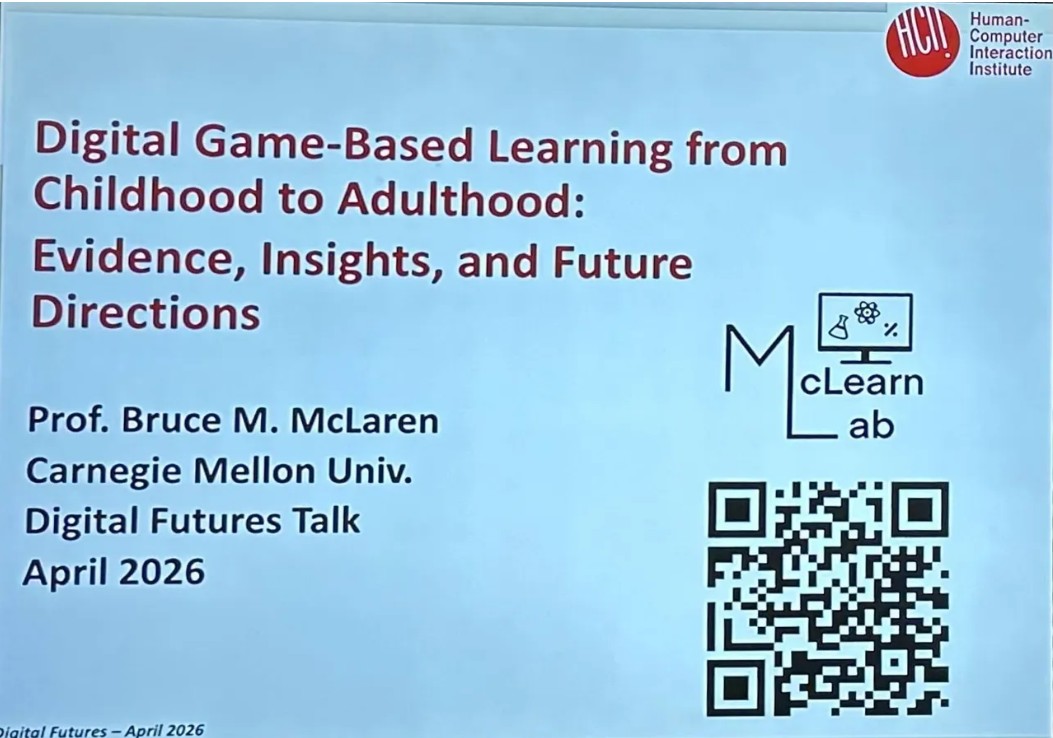
Digital Game-Based Learning (GBL) is no longer just a “child’s” tool. In presentation on 16 April 2026 by Professor Bruce M. McLaren (Carnegie Mellon University), a fundamental shift was highlighted: the question today is not “Can adults learn through games?” but rather, “When and how do games improve real-world performance?”
The Line Between Games and Gamification
For effective implementation, it is crucial to distinguish between two approaches:
* Digital Learning Games (GBL): Products originally created as games. They are built on rules, fantasy, and challenges, harmoniously blending instructional and entertainment goals.
* Gamification: Conventional educational or work processes where gaming elements (points, badges, leaderboards) are added to increase engagement.
Evolution: Children vs. Adults
Professor McLaren identifies clear differences in the design approaches for different age groups:
Child GBL
* Fantasy driven
* Shorter interaction cycles
* High visual engagement
* Focus on foundational skills
* Learning gains
Adult GBL
* Real-world simulations
* Longer narratives with transfer to workplace tasks
* Longer sustained engagement
* Focus on complex problem solving
* Performance in complex, real-world tasks
Difference between Digital Learning Games and Gamification
Digital Learning Game:
* Originally created as a game
* Players engage in artificial activities, involving fun, challenge, fantasy`
* Both instructional and entertainment goals
* Pre-defined game rules
Gamification:
* Not originally a game
* Gaming elements added, most commonly points, badges, leaderboards, interactive and playful agents.
Andragogy: Why Adults Play Differently
Adult learning is based on Malcolm Knowles’ principles. Games for this audience must address their need to know, build upon existing experience, and maintain a problem-centered orientation. Adults are motivated when they see how a game scenario helps them in business, medicine, or the military (e.g., projects like Simformer or Pacific: The Leadership Game).
Future Directions
The development of GBL in the coming years will be inextricably linked with Artificial Intelligence:
1. AI/LLM-Powered NPCs: Using Large Language Models will allow for the creation of non-player characters that act like real people, providing not only cognitive but also meta-cognitive and affective feedback.
2. AI-Assisted Design: LLMs will assist in generating ideas and providing design guidance to game developers.
3. Tangible GBL and Wearables: The advancement of systems like NORILLA and wearable tutors, supported by AI, will bridge the gap between the physical world and digital learning.
Current Areas of Focus
Despite its popularity, the evidence base for the effectiveness of adult GBL remains “uneven.” The industry’s primary priorities today are:
* Large-Scale Studies: Most current data is based on small pilot groups. Research with samples of over 100 subjects and rigorous pre-post analysis is needed.
* Measuring Real-World Performance: The focus must shift from “Do employees like the game?” to “How has their workplace performance changed?”
* Empirical Analysis: Many successful corporate games (from Renault Way to Global Conflicts) require deeper study of their learning mechanisms to establish industry-wide standards.
Summary: We are entering an era where a game is not a break from work, but a high-tech simulator that allows for the honing of complex skills in a safe digital environment.
Leave a Reply